Pragmatic Inquiry and Religious Communities by Brandon Daniel-Hughes
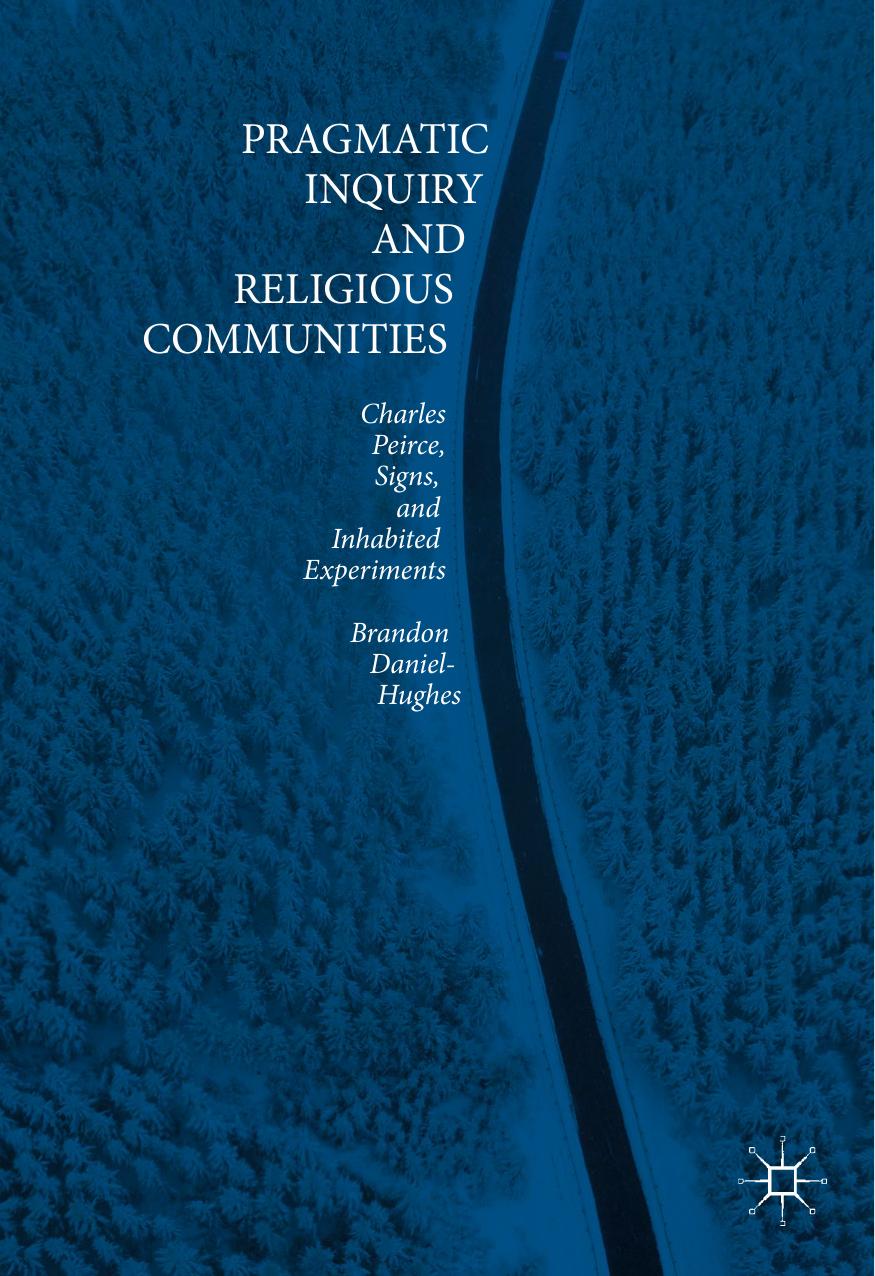
Author:Brandon Daniel-Hughes
Language: eng
Format: epub, pdf
ISBN: 9783319941936
Publisher: Springer International Publishing
These two brief passages elegantly tie together aspects of the imperative of communal coordination that deserve further comparison to the governing Pragmatism of my larger argument. First, Butler , while not an avowed pragmatist, echoes both Peirce and Dewey in highlighting the emergent quality of obligation, tying the experience of value to our habitual, emotional, and affective entanglements with the world. Second, Butler ties the natural condition of obligation to precarious life, noting that all life is a conditioned and conditioning process. This notion of reflexive conditioning is reminiscent of Peirce âs warning that â[t]he individual man [â¦] so far as he is anything apart from his fellows, and from what he and they are to be, is only a negationâ (CP 5.317). But Butler , while less metaphysically oriented than Peirce , is more explicit about the emergent imperative. We do not choose to be implicated in the flourishing of our fellow creatures any more than we choose to be dependent on the countless communities of creatures and social forms that sustain our bodily and psychological health. The axiological imperative was not foreign to Peirce and one can locate conceptions of emergent normativity in his discussions of continuity, but Butler âs concept of precariousness more explicitly foregrounds ethical obligations.3 âPrecariousness,â in her careful formulation, âgrounds such positive social obligations (paradoxically because precariousness is a kind of âungroundingâ that constitutes a generalized condition for the human animal) at the same time that the aim of such obligations is to minimize precariousness and its unequal distributionâ (Butler 2009, p. 22). Precariousness is a general condition of life, but that is not to say that it is uniformly experienced. Thus, insofar as individuals and communities work to manage and minimize their own precariousness, they inevitably alter the conditions of others, sometimes for the better, often for the worse. Both synechism and precariousness entail that individuals and communities constitute habitats for others and thereby affect others through every decision and action. Where Butler and Peirceans might find common ground is in their desire to minimize precariousness and maximize the experience of value for as many as possible even as both positions recognize that life presupposes death and the inevitability of not actualizing all possible values.
This too brief introduction of Butler âs concept of precariousness is necessary to correct for some of Peirce âs own elitist blind spots (see Chap. 2 of Atkins 2016). But most importantly, Butler emphasizes the reality of unactualized possibilitiesâa concept that Peirce acknowledged in his logical studies but did not treat with sufficient care in his work on inquiryâand loss, handling these as occasions of grievability . Precariousness, as well as a robust conception of synechism, demands the acknowledgment that communal consensus and coordination , even when recognized as the legitimate aim of inquiry, is always a determinate achievement of value that requires the sacrifice and loss of other values that are nonetheless real and grievable. I expect that most readers are aware of the inherent dangers of advocating
Download
Pragmatic Inquiry and Religious Communities by Brandon Daniel-Hughes.pdf
This site does not store any files on its server. We only index and link to content provided by other sites. Please contact the content providers to delete copyright contents if any and email us, we'll remove relevant links or contents immediately.
| Anthropology | Archaeology |
| Philosophy | Politics & Government |
| Social Sciences | Sociology |
| Women's Studies |
Cecilia; Or, Memoirs of an Heiress — Volume 1 by Fanny Burney(32558)
The Great Music City by Andrea Baker(32019)
Cecilia; Or, Memoirs of an Heiress — Volume 2 by Fanny Burney(31956)
Cecilia; Or, Memoirs of an Heiress — Volume 3 by Fanny Burney(31942)
We're Going to Need More Wine by Gabrielle Union(19046)
All the Missing Girls by Megan Miranda(16028)
Pimp by Iceberg Slim(14507)
For the Love of Europe by Rick Steves(14121)
Bombshells: Glamour Girls of a Lifetime by Sullivan Steve(14075)
Talking to Strangers by Malcolm Gladwell(13370)
Norse Mythology by Gaiman Neil(13365)
Fifty Shades Freed by E L James(13241)
Mindhunter: Inside the FBI's Elite Serial Crime Unit by John E. Douglas & Mark Olshaker(9343)
Crazy Rich Asians by Kevin Kwan(9292)
The Lost Art of Listening by Michael P. Nichols(7506)
Enlightenment Now: The Case for Reason, Science, Humanism, and Progress by Steven Pinker(7313)
The Four Agreements by Don Miguel Ruiz(6765)
Bad Blood by John Carreyrou(6621)
Weapons of Math Destruction by Cathy O'Neil(6280)
